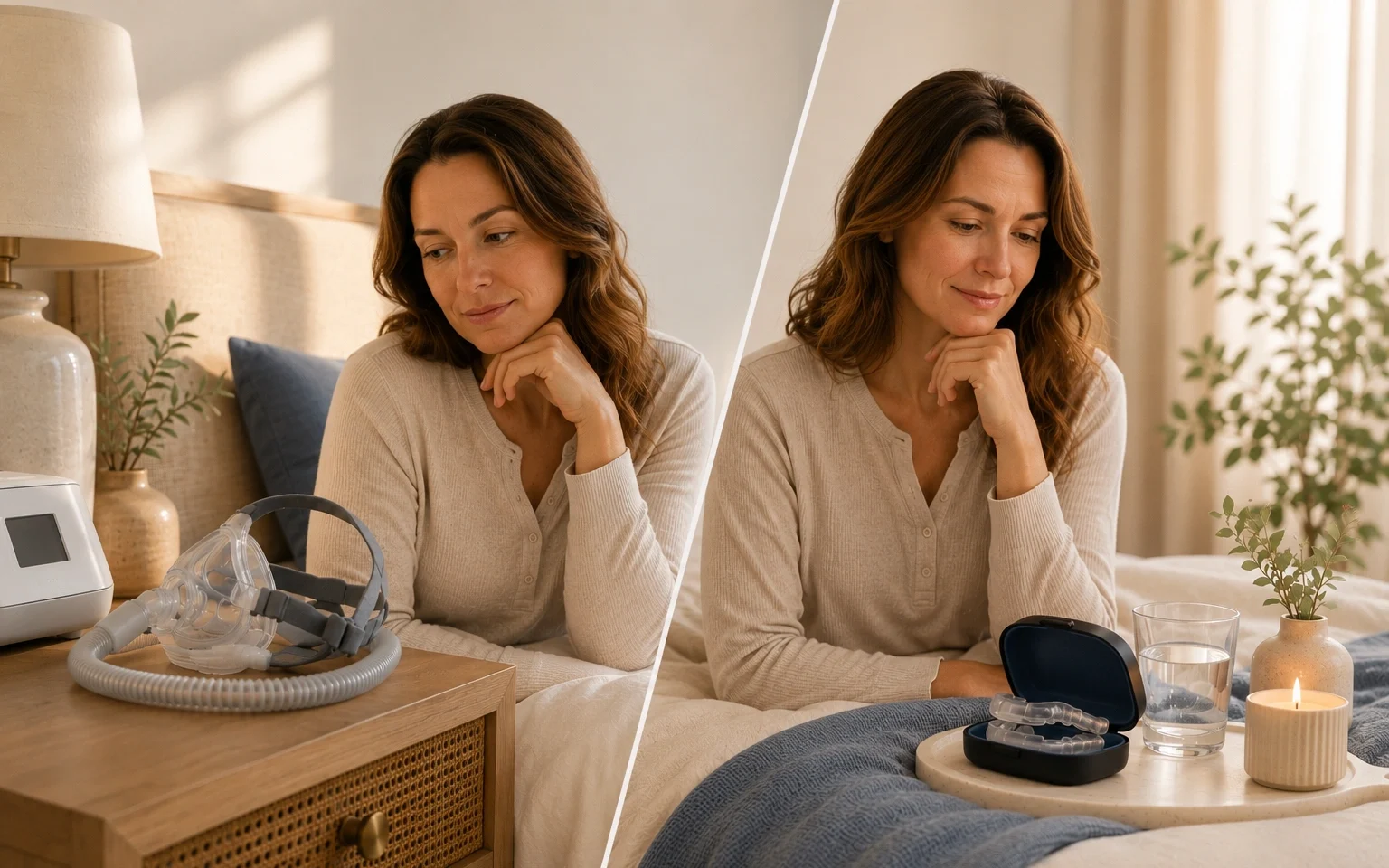

“I don’t want a CPAP.”
I hear that almost every day.
Sometimes it’s because someone was just diagnosed and the idea of sleeping with a mask feels overwhelming. Sometimes it’s because they tried CPAP and couldn’t tolerate it. And sometimes it’s because they’re not looking for another device—they’re looking for a solution that makes sense for their body and their life.
Whatever the reason, this conversation has changed dramatically over the last few years.
For a long time, sleep apnea treatment was viewed through a very simple lens: get diagnosed, get a CPAP, problem solved.
Today, we know it’s more complicated than that. CPAP remains an excellent treatment for many patients, but it is no longer the only option. More importantly, successful treatment isn’t always about finding the right device. It’s about understanding why the airway is struggling in the first place.
Let’s start with an important point: CPAP works.
For many patients, it’s highly effective at reducing sleep apnea events, improving oxygen levels, and lowering the stress sleep apnea places on the body. But CPAP does not permanently change the airway. It uses air pressure to keep the airway open while you’re sleeping. When the machine is on, the airway stays open. When it’s off, the airway returns to its natural state.
That doesn’t make CPAP bad. It simply means CPAP manages the condition rather than changing the underlying factors that may be contributing to it.
Patients also deserve to understand what living with CPAP actually involves. There’s usually an adjustment period. The equipment needs routine cleaning and maintenance. Supplies need to be replaced. Travel takes planning. Electricity is required. Depending on the machine and where you’re traveling, distilled water and outlet conversion may also be part of the equation. And while many people adapt very well, others find long-term use challenging.
Understanding those realities doesn’t make someone anti-CPAP. It makes them informed.
Oral appliance therapy—often called a mandibular advancement device—is one of the most common alternatives to CPAP. These custom-made appliances work by positioning the lower jaw forward during sleep, which can help create more space behind the tongue and reduce airway collapse.
For many patients, they’re easier to tolerate than CPAP. They’re quiet, portable, travel-friendly, and they don’t require electricity.
I’ve worked extensively with patients using sleep appliances, and the questions I get asked all the time are, “Will wearing this appliance teach my jaw where it needs to be while I’m sleeping so eventually I won’t need it?” and “How long will I have to wear this?”
The answer surprises many people. An oral appliance positions the jaw while you’re wearing it, but it does not automatically retrain the muscles that support the airway. It does not automatically correct tongue posture, improve nasal breathing, or change the functional habits that may have contributed to the problem in the first place.
Think about wearing a knee brace. The brace may provide support while you’re wearing it, but that doesn’t necessarily mean the muscles controlling the knee have changed. The same principle applies here.
The appliance can be highly effective at managing the airway during sleep, but it doesn’t teach the tongue where it should rest, retrain swallowing patterns, or improve oral muscle function on its own. That’s one reason I often view sleep appliances and myofunctional therapy as complementary rather than competing approaches. One helps create a more favorable airway position during sleep. The other focuses on improving the muscle function that supports the airway every day.
Patients should also know that oral appliances require follow-up care. Some people experience temporary jaw soreness. Others may notice bite changes over time. And patients with TMJ concerns should have a thoughtful discussion with their provider before treatment begins.
One of the biggest developments in sleep medicine has been the growing role of GLP-1 medications. For patients whose sleep apnea is significantly influenced by excess weight, medications such as Zepbound are creating new opportunities.
This is an important shift. In December 2024, the U.S. Food and Drug Administration approved Zepbound as the first medication for moderate to severe obstructive sleep apnea in adults with obesity, to be used along with a reduced-calorie diet and increased physical activity. The FDA describes the improvement in sleep apnea as likely related to body-weight reduction, which remains the clearest established mechanism. At the same time, emerging reviews suggest tirzepatide may also influence sleep apnea through broader metabolic effects, including reduced systemic inflammation, but that part of the story is still evolving.
That nuance matters, because not every patient with sleep apnea has obesity, and not every airway problem is primarily weight-related. Even when weight and inflammation are part of the picture, medication still comes with side effects, cost considerations, medical monitoring, and long-term decisions. Weight may be part of the story. Inflammation may be part of the story. But for many patients, neither is the entire story.
One of the most talked-about developments in sleep medicine right now is AD109, a sleep apnea pill that is still being reviewed by the FDA. It’s getting attention because two large studies showed promising results. One followed patients for about six months, and the other showed the improvement could last closer to a year. That matters because it suggests the medication may not just help in the short term—it may continue helping over time. The company has now submitted those results to the FDA for review, but the medication is not approved yet.
The medication is designed to support the neuromuscular activity that helps keep the airway open during sleep. As someone who spends every day evaluating oral muscle function, I find that fascinating—because it acknowledges something that has often been overlooked: the airway is not just anatomy. The airway is also function.
Muscles matter. Tongue posture matters. Breathing patterns matter too.
The difference is that medication attempts to influence muscle function pharmacologically. Myofunctional therapy approaches the same concept through training and retraining the muscles themselves. Medication may ultimately become a valuable tool for many patients, but it also comes with the realities of any medication: side effects, cost, access, long-term use, and ongoing medical management.
This is where my work begins.
When I evaluate a patient, I’m looking beyond the sleep study. I’m evaluating the everyday functional patterns that can influence the airway, including:
One of the most overlooked contributors to sleep-disordered breathing is low tongue rest posture. The tongue is one of the primary muscles supporting the airway. When it isn’t functioning optimally, breathing patterns often change. Nasal breathing may become more difficult. Mouth breathing becomes more common. Sleep quality may suffer.
Myofunctional therapy focuses on improving how these muscles function every day—not just while a device is being worn.
In my experience, the most successful patients are rarely relying on just one thing. They’re improving oral muscle function, supporting nasal breathing, optimizing sleep habits, addressing lifestyle factors, and using the right treatment tools for their specific airway needs.
The goal is not simply reducing a number on a sleep study. The goal is improving function.
One of the biggest misconceptions in healthcare is that every condition should have one provider and one solution. Sleep apnea doesn’t work that way.
The best outcomes often come from collaboration. Depending on the patient, that may include sleep physicians, dental sleep providers, ENT specialists, weight management specialists, and myofunctional therapists. Each provider addresses a different piece of the puzzle.
No single treatment solves everything, and no single provider sees everything. The future of sleep apnea treatment isn’t about choosing sides. It’s about understanding how the pieces fit together.
If you’ve been diagnosed with sleep apnea and you’re struggling with CPAP, don’t assume your only choices are to wear the machine or do nothing. Today’s treatment options are broader than ever.
The key is understanding which approach fits your airway, your anatomy, your lifestyle, and your goals.
My role is to help you understand the functional side of the equation: how you breathe, where your tongue rests, how your muscles are functioning, and whether those patterns may be contributing to your sleep-disordered breathing.
Because the best treatment plan isn’t the one everyone else is using. It’s the one that addresses the factors affecting your airway.
If this sounds like you, I’m your person.
Schedule your comprehensive, airway-focused evaluation, and let’s start connecting the dots.
This article is for educational purposes only and is not a substitute for individualized medical advice, diagnosis, or treatment.
If breathing feels off, sleep isn’t restorative, or your body feels like it’s constantly compensating, there’s usually a reason.

I guide adults in developing proper tongue posture to support jaw alignment, improve airway function, and reduce tension. Healthy tongue positioning contributes to better breathing, improved sleep, and less stress-related muscle strain.
I help adults retrain consistent nasal breathing and establish a natural lip seal to reduce mouth breathing, improve oxygen intake, and support better sleep and daytime energy. Healthy breathing patterns are foundational to long-term airway function and overall well-being.